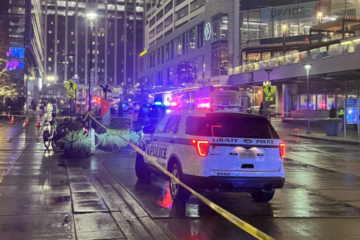










Washington Traffic FAQ
Tuesday - 12/11/2012, 4:48pm  ET
There are a number of reasons why we don't tell you what the police or fire
department activity is. Police could be doing a routine truck inspection check or
a sobriety check point. We don't want to tip off potential offenders to what's
going on, but we want to alert the general public why there is a traffic tie up.
Every day, in the D.C. area, we have "suspicious packages" that close streets. We
don't want to create panic in the area every time this happens, so we call it fire
department activity.
Why do you only report on Maryland traffic? Do you hate Virginia?
Our reports lead off with whatever traffic incident is impacting the most
listeners in our area, whether it's in Maryland, Virginia or the District. Then
we cover the rest of that state, before moving to another area.
Why do you only report on Virginia traffic? Do you hate Maryland?
See the question above.
Why can't you refer to a direction on the Beltway, instead of Inner and Outer
Loop, which is confusing?
Yes, the Inner and Outer Loops of the Beltway can be confusing. However, the
Beltway has an Inner and Outer Loop because it's a circle and changes direction.
Technically, there are two stretches of all directions, north, south, east and
westbound on Interstate 495 that are not related. Using the directions the
Beltway
travels would be very confusing! There could be an accident on southbound I-495
with a
backup that stretches across westbound I-495 and onto northbound I-495, however it
would not affect the other southbound, westbound or northbound I-495. Confusing,
right?
For simplicity, Inner and Outer Loops were created and signed on the highway to
help people identify which loop they're on and help traffic reporters explain to
motorists what's going on. Think of it as clockwise and counter clockwise. At
WTOP, we also try to use town names, such as "if you're traveling on the Outer
Loop of the Beltway, from Greenbelt (NB 495), around through Silver Spring and
Bethesda (WB 495), past I-270 and across the American Legion Bridge (SB 495) into
Virginia…". We do that because we know how confusing directions on the Beltway
are for people.
Why don't you report speed traps?
See also the question about police activity. The main reason is that you
shouldn't be speeding. The other reason is that we concentrate our reports on
traffic problems, not where the speed traps are located.
Why do you always say that "all lanes are open", yet I'm stuck in slow traffic?
This is really a D.C. thing. When we report that all lanes are open, we mean that
there isn't an incident, such as an accident or a broken down vehicle, in your
way; it's just rush hour traffic. Most people can deal with normal day-to-day
traffic, but incidents make that much worse. As long as you know that there's
nothing in your way except normal traffic, you can deal with it better.
I've been sitting in this delay for half an hour and you didn't mention it.
Why
not?
We probably didn't mention it because we didn't know about it or how bad it is.
Although we try to be everywhere at once, it's impossible. That's why we say "if
you see something we're not reporting or to update us on something we are
reporting, call us, at #1035". Nothing beats a firsthand account of what's going
on, so we welcome calls from listeners, who can fill in the blanks with
information we don't know.
Who has the right of way in a traffic circle?
First, let me explain why traffic circles were invented. They were invented to
slow traffic down at busy intersections where traffic lights weren't needed.
Unless there are signs to the contrary, traffic already in the circle has the
right of way, so slow down on your approach to the circle and enter when it is
clear. Once you're in the circle, don't forget how to get out! To exit most
circles, you have to be on the right. Don't panic if you miss your way out, just
ride around the circle one more time and work your way over to the right side of
the circle. Remember, traffic circles are intended to slow traffic, so slow down
and be careful.
Why don't people put their headlights on when it's raining or snowing?
We can't explain why people do what they do, but we can tell you what the law
states. In Virginia and Maryland, it's the law to have your headlights on when
your wipers are on. The District does not have that law. Regardless, it's common
sense. During inclement weather, your goal should be to see and be seen.
Headlights are used not only to see, but so that other drivers can see you. It
may be the law in most states, but it's also common sense safety.
How do mile markers on roadways work?
Mile markers on highways are there so we know exactly where you are on a highway.
This helps departments of transportation crews, tow trucks and first responders
trying to get to an accident. The rule for north/south roads is that the mile
markers begin at the southern end of the road and progress north. On east/west
highways, the mile markers begin at the western end and progress east. Most
states have also converted exit numbers to match up with mile markers. Where's
the exception to this rule? The New Jersey Turnpike won't match up their mile
markers with the exit numbers, opting to hold onto their exit numbers 1 to 16,
since
most people from New Jersey know the exit numbers of the highway between the
Delaware Memorial Bridge (Exit #1) and the George Washington Bridge (Exit #16).
Is it true that highway numbers correspond with which direction they run?
It is true, for most scenarios across the country, however there are always exceptions! Odd numbered highways, such as I-95, Rt. 1 and Rt. 29, travel north and south and even numbered highways, such as Rt. 50, I-66 and I-70 travel west to east. Are there exceptions? Yes. Take Rt. 7, for example, which is an odd roadway, which runs east and west.